AliExpress用户增长之登录注册
User Growth — Login & Registration
项目背景 Project Background
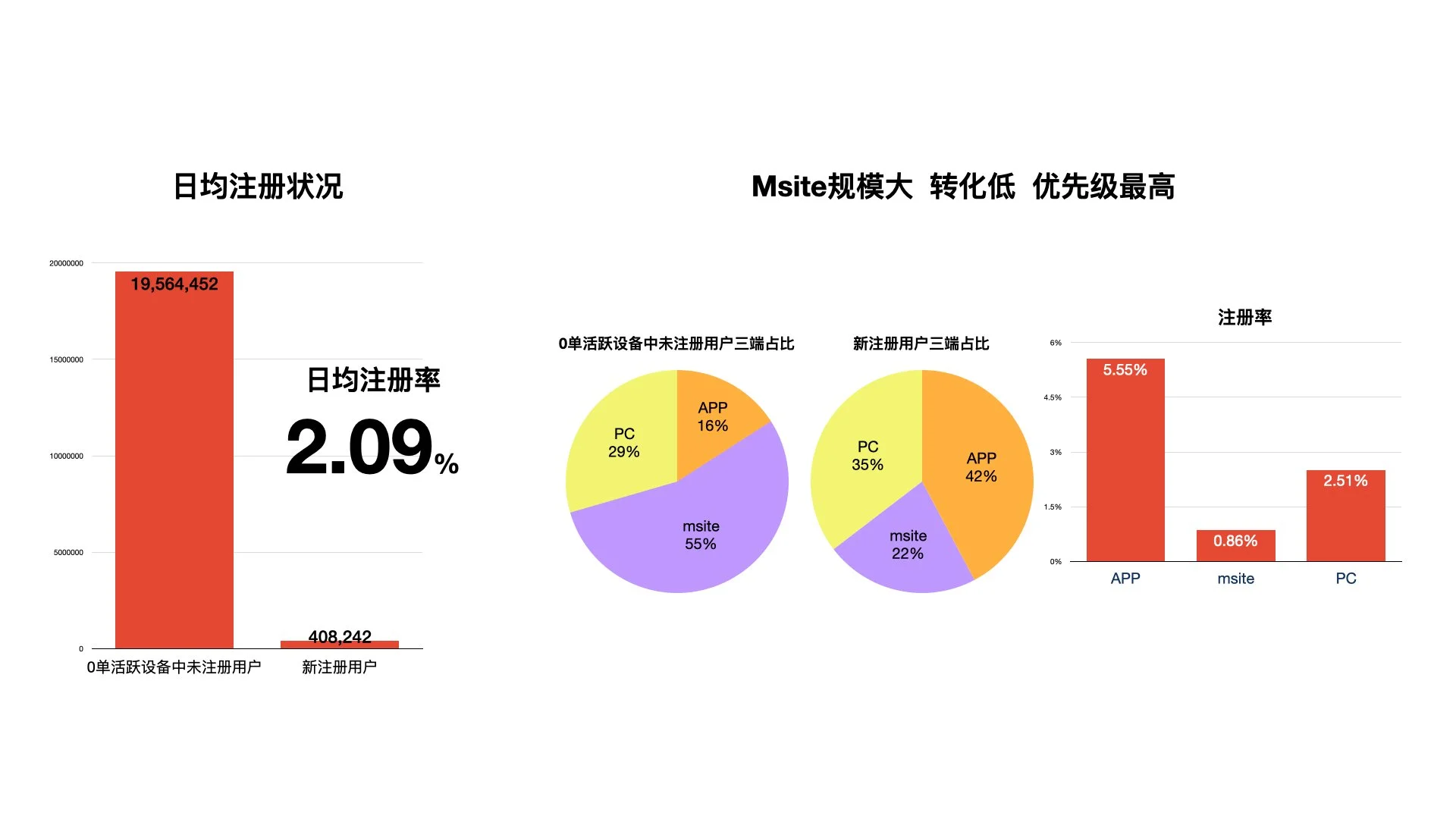
AliExpress每天有2000万左右的未注册用户进来AE只有2%的用户注册(Msite占比55%,注册率0.86%;PC占29%,注册率0.86%;app占16%,注册率5.55%)。从数据来看登录注册规模大、转化率低,又是设计可以重点发力的,是个绝佳的机会点。
AliExpress receives approximately 20 million unregistered users per day, yet only around 2% of them register.
Mobile site: 55% of traffic · 0.86% registration rate
PC: 29% of traffic · 0.86% registration rate
App: 16% of traffic · 5.55% registration rate
The data revealed a clear opportunity: high user volume, but extremely low registration conversion.
Since login and registration are key entry points into the broader user journey, I identified this as a high-impact area where product and experience design could directly contribute to user growth.
现状分析 Situation Analysis
数据 Data
(限制条件:1. 数据仅为app端,PC与msite正在推动埋点;2. 第三方的数据无法将登录与注册分开,所以只要这里的成功率是注册登录总体的成功率。)
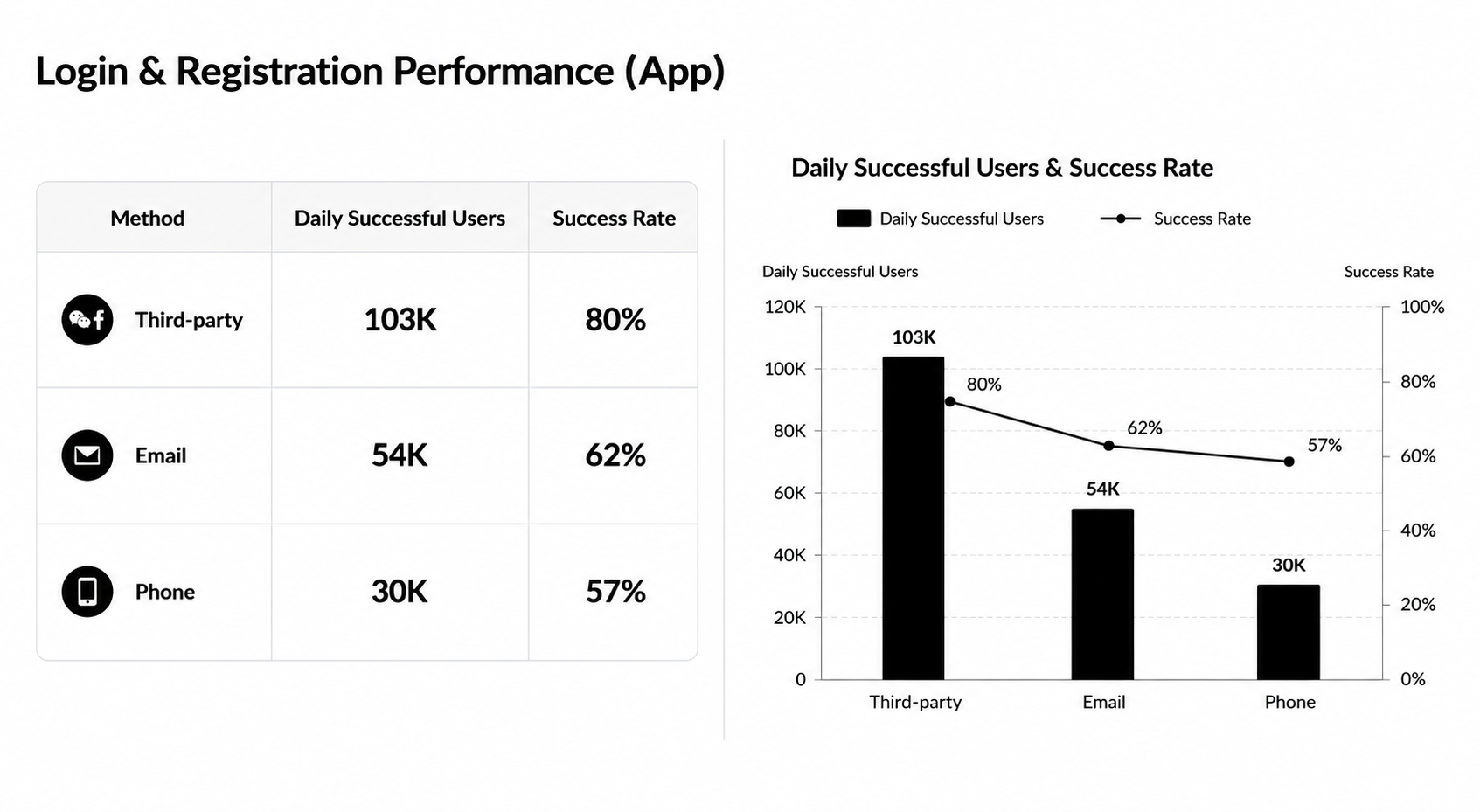
目前登录注册有3种方式:第三方、邮箱、手机号。从规模、转化两个维度看数据:每日注册成功人数占比依次为:10.3w、5.4w、3w;成功率依次为:80%,62%,57%。
是什么原因导致了注册成功率这么低?并且这些原因各自占比是多少?我又深入去挖掘了失败的原因及占比。
Constraints: The data is currently available only for the App; tracking for PC and M-site is still being implemented. Third-party data does not distinguish between login and registration, so the success rates below represent the combined login/registration success rate.
Currently, users can log in or register through three methods: Third-party, Email, and Phone.
Despite the significant volume of users entering the login and registration flow, success rates remained relatively low, particularly for Email and Phone.
This raised the next question:
What was preventing users from completing login or registration, and how much did each friction point contribute to the overall drop-off?
I therefore drilled down into failure reasons and their respective proportions to identify the key opportunities for improvement.
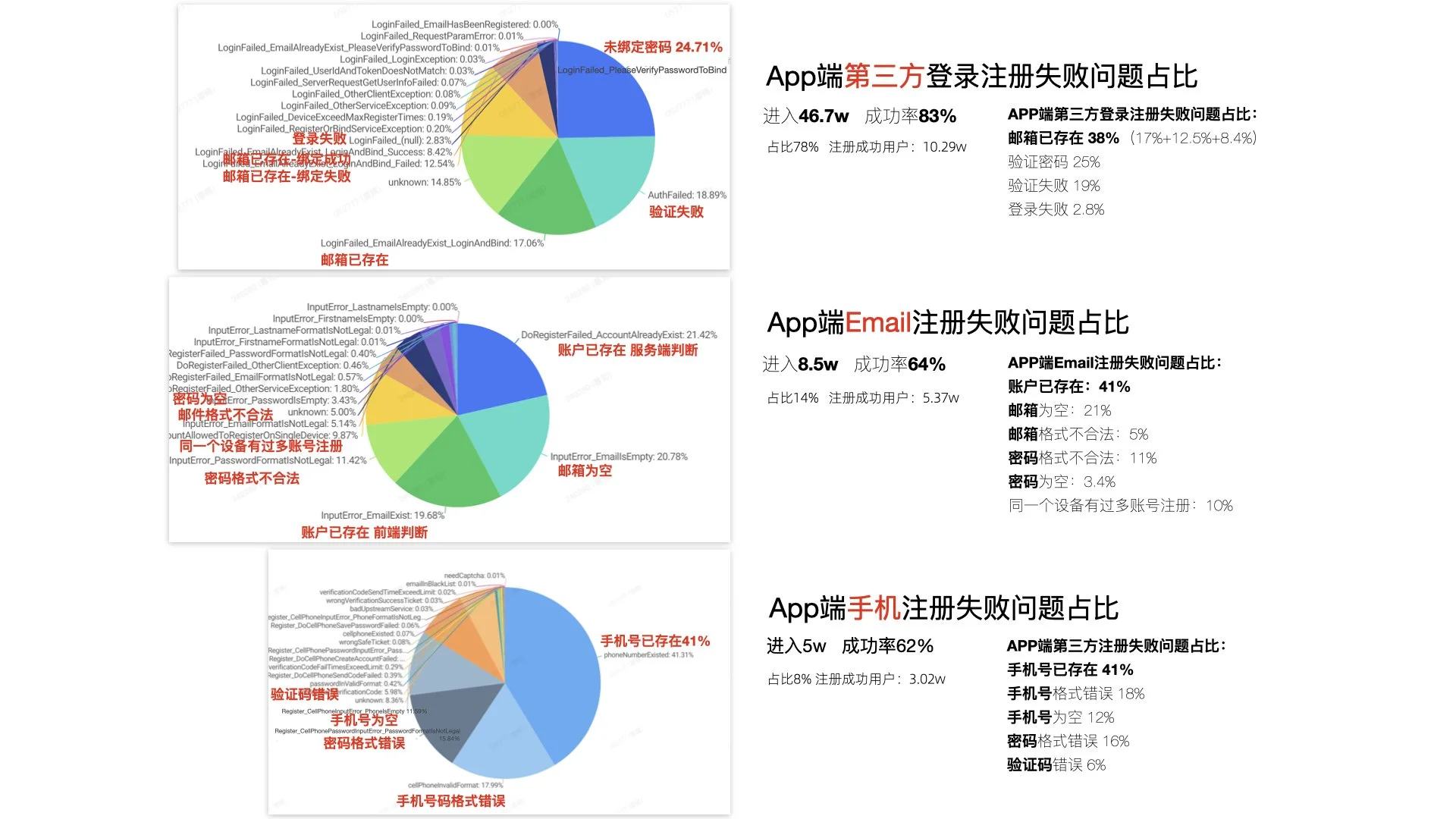
三种方式中,点击“提交”按钮后报错原因:1. 重复注册的用户占比40%;2. 格式错误占比40%。格式错误的问题好解决,无需再从数据层面深挖,直接通过现有链路走查+竞品分析来优化设计。而重复注册的问题,从数据显示app端每日访问的用户中 80%是已经登录的。为什么那么多已经注册过的人,还要重复注册而不是去登录呢?带着这个问题我做了一次用户调研。
Among the three methods, the main error reasons after users clicked “Submit” were:
Duplicate registration — 40%
Format errors — 40%
Format errors were relatively straightforward to address. Instead of further analyzing the data, I directly conducted a user flow review and competitor analysis to identify design opportunities.
The more interesting issue was duplicate registration.
Data showed that 80% of daily App users were already logged in. This raised a key question:
Why were so many existing users attempting to register again instead of logging in?
I took this question into user research to understand the underlying behavior and identify the friction points behind duplicate registration.
用户调研 User Research
我找了8名app端目标国家用户,从5个维度做了一次深度调研:1. 对AE的第一印象;2. 会因为什么原因想要注册账号;3. 演示一遍注册流程;4. 注册失败原因;5. 最喜欢的2个网购平台。结论如下:
I conducted in-depth interviews with 8 target-market App users, exploring their experience across five dimensions:
First impression of AliExpress
Motivations for creating an account
Registration flow walkthrough
Reasons for registration failure
Two preferred e-commerce platforms
Key Findings:
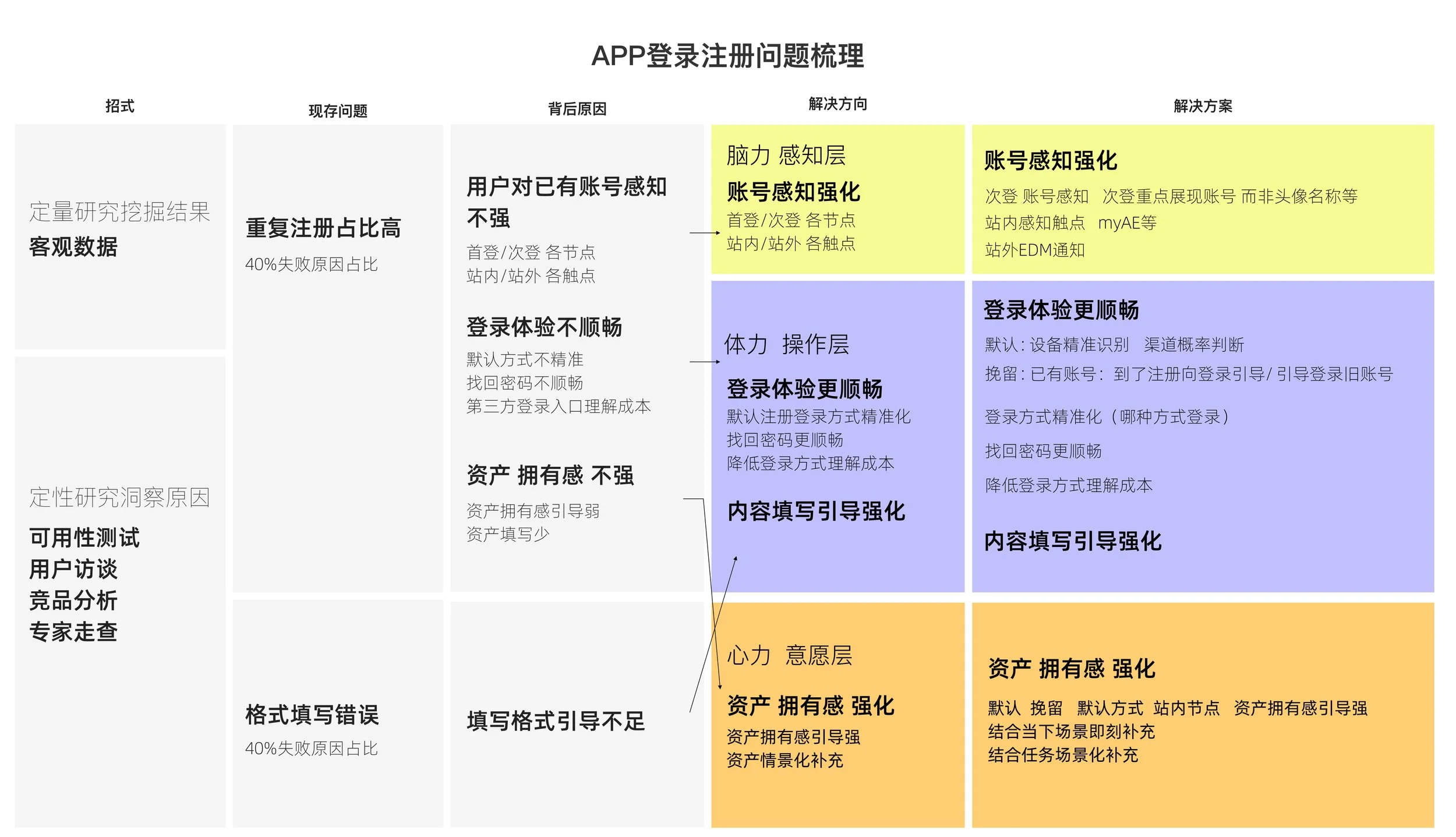
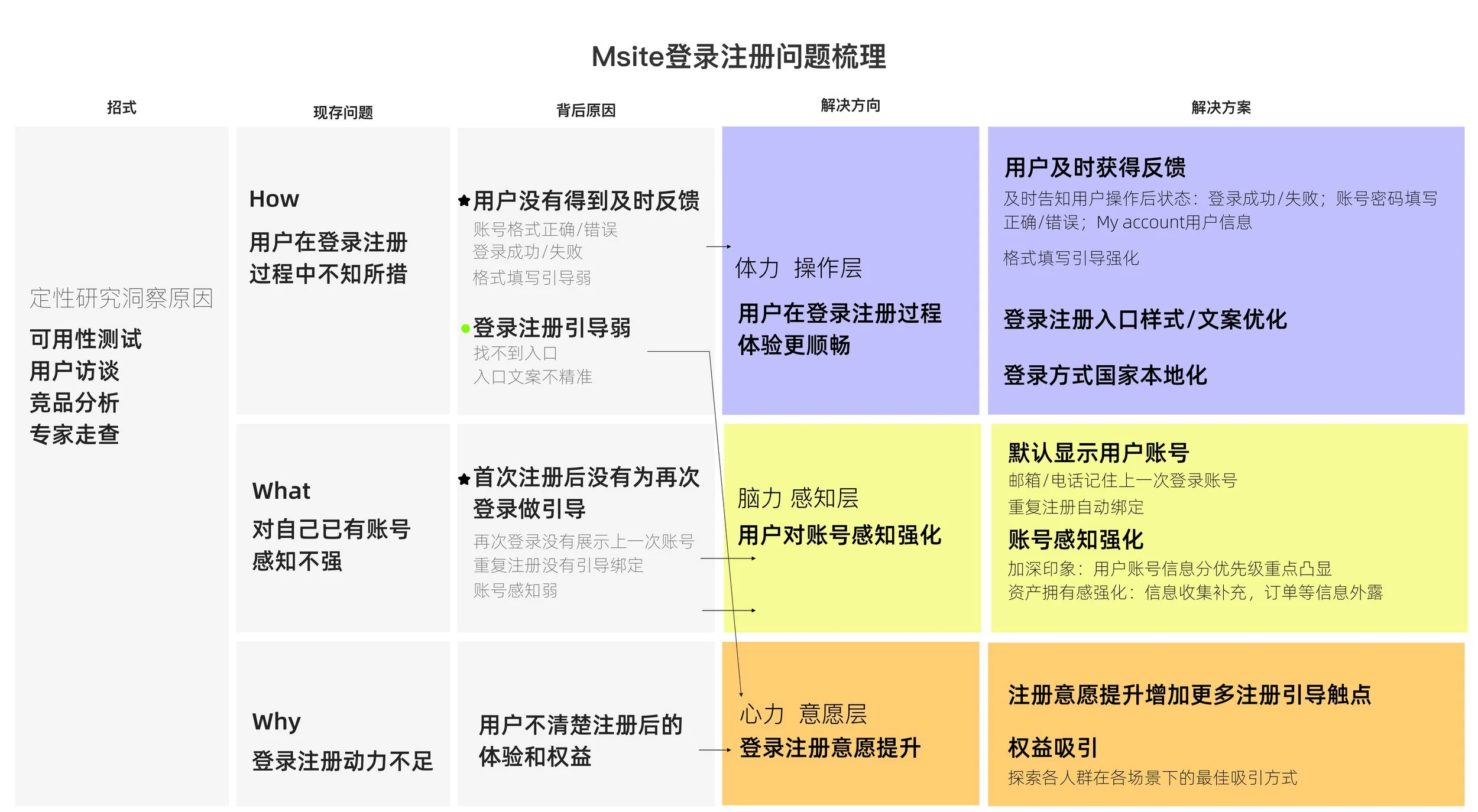
用同样的方式,我又针对PC/Msite分别各找了8名用户做调研,问题基本相似,结论如下:
Using the same approach, I conducted separate user research sessions with 8 PC users and 8 mobile site users. The questions were largely consistent with the App research, and the key findings were as follows:
设计策略 Design Strategy
设计优化分为三个阶段:体验升级、扩大规模、减少垃圾注册率&提升用户注册质量。针对Msite、PC、App端的特殊性分别进行优化。前面提到Msite的占比是三端最高的(55%),所以优先优化了Msite,顺带PC一起。这样能更快拿到数据验证结果,顺势推动app端优化
第一阶段:体验升级
1. PC/Msite1.0: 漏斗内 登录注册体验优化.
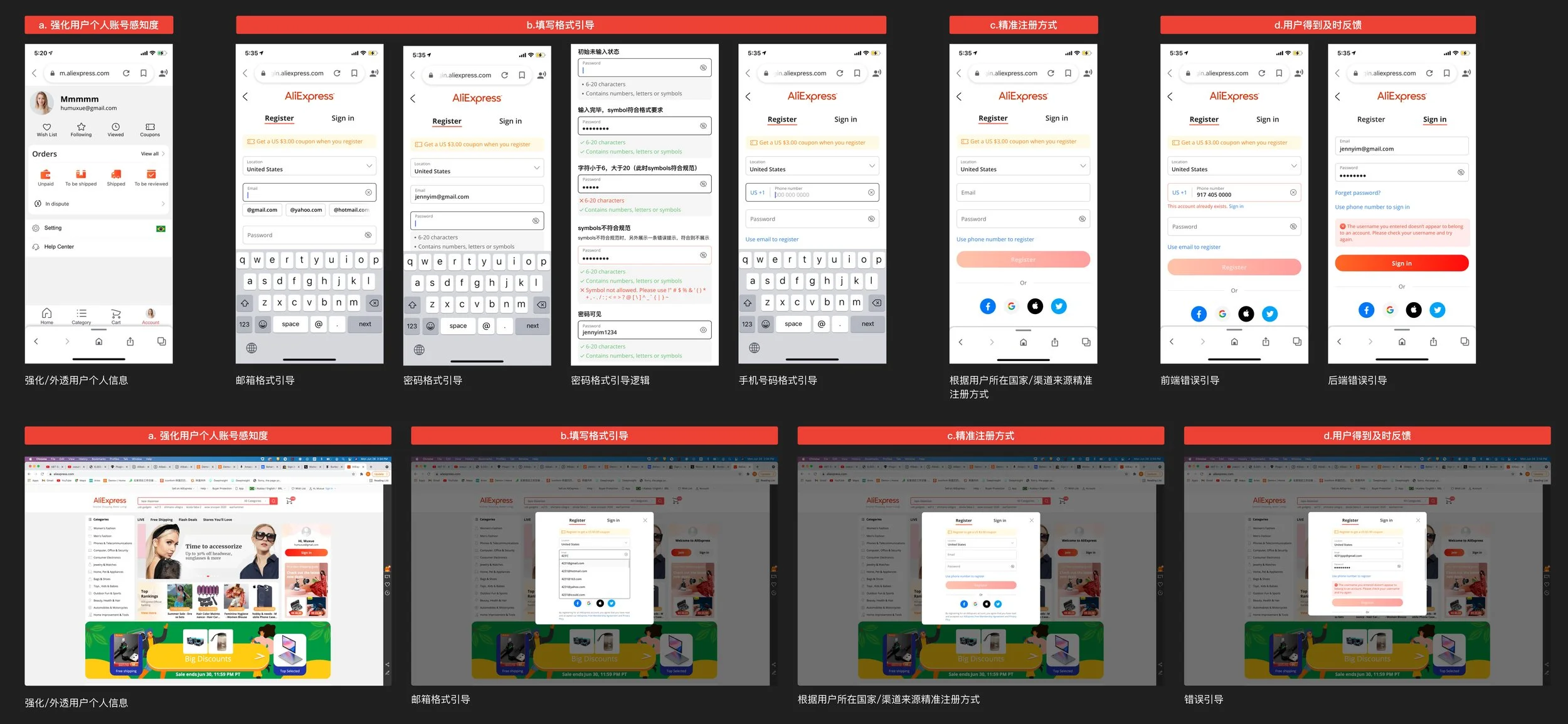
核心抓手:a. 强化用户个人账号感知度;b.填写格式引导;c.根据国家/渠道来源精准注册方式;d.用户得到及时反馈;
I structured the optimization into three phases:
Experience Upgrade → Scale Growth → Reduce Spam & Improve Registration Quality
Each phase addressed the specific characteristics of M-site, PC, and App.
Since M-site accounted for the largest share of traffic (55%), I prioritized M-site first, together with PC. This allowed us to validate the design changes with data faster, then use the results to drive optimization on the App.
Phase 01 — Experience Upgrade
PC / Mobile site 1.0 — Login & Registration Experience
Core Design Levers:
Strengthen Account Awareness — Make users clearly understand their account and login/registration status.
Input Guidance — Provide clear formatting guidance to reduce input errors.
Contextual Registration — Recommend the most appropriate registration method based on country and traffic source.
Immediate Feedback — Provide timely and clear feedback throughout the registration process.
数据结果:
AB实验(50%vs50%)PC手机邮箱注册成功率提升5.52pt(62.98%→68.5%),报错率下降18.12%(27.67%→9.55%);Msite手机邮箱注册成功率提升6.75pt(54.94%→61.68%),报错率下降26.40%(36.80→10.40)
Data Results
A/B Test (50% vs. 50%)
PC — Phone & Email Registration: Success rate increased by 5.52pp (62.98% → 68.50%), while error rate decreased by 18.12pp (27.67% → 9.55%).
M-site — Phone & Email Registration: Success rate increased by 6.75pp (54.94% → 61.68%), while error rate decreased by 26.40pp (36.80% → 10.40%).
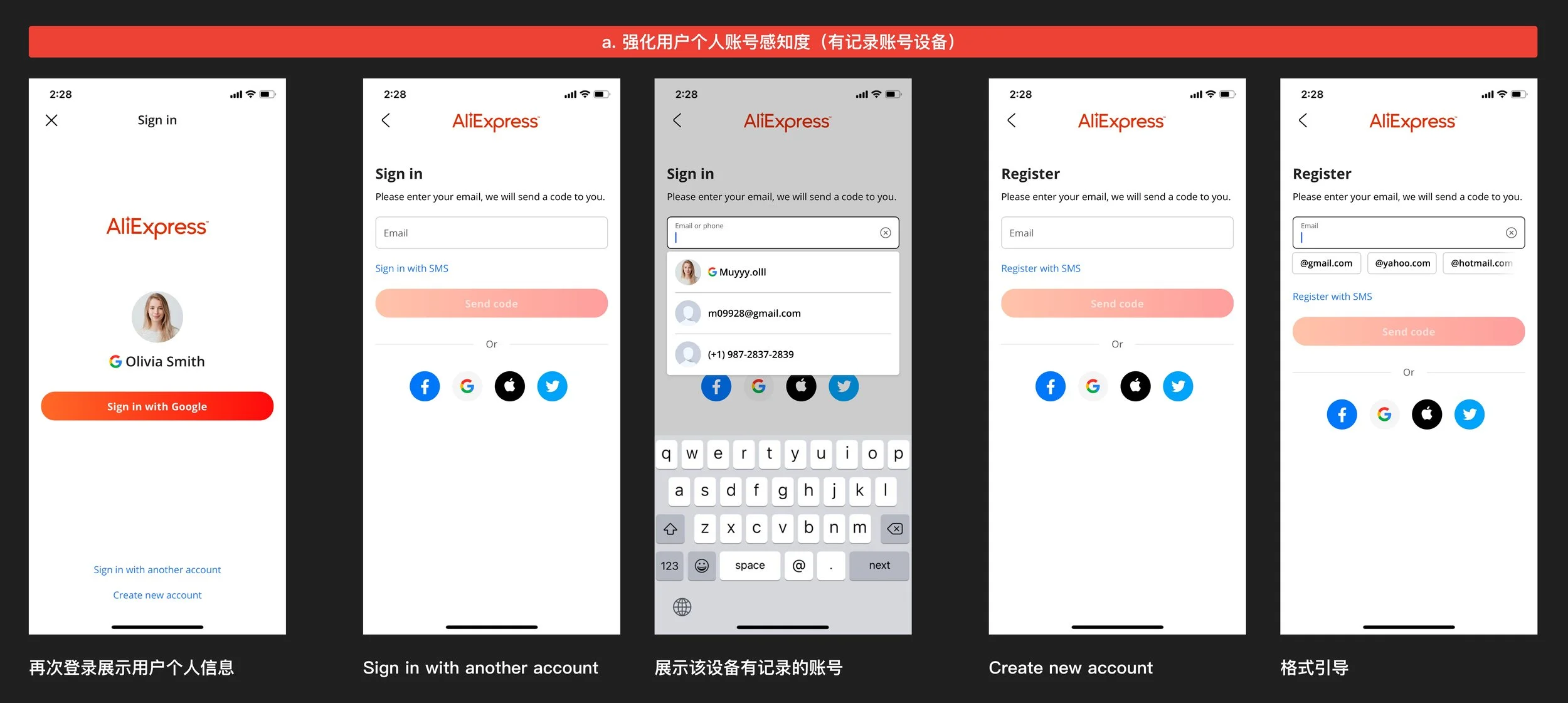
2. App1.0: 漏斗内 登录注册体验优化
核心抓手:a. 强化用户个人账号感知度;b.填写格式引导;c.根据国家/渠道来源精准注册方式;d.用户得到及时反馈;
2. In-Funnel Login & Registration Experience
Core Design Levers:
Strengthen Account Awareness
Provide Clear Input Guidance
Personalize Registration Methods based on country and traffic source
Provide Timely Feedback throughout the flow
3. App1.0: 链路间优化.
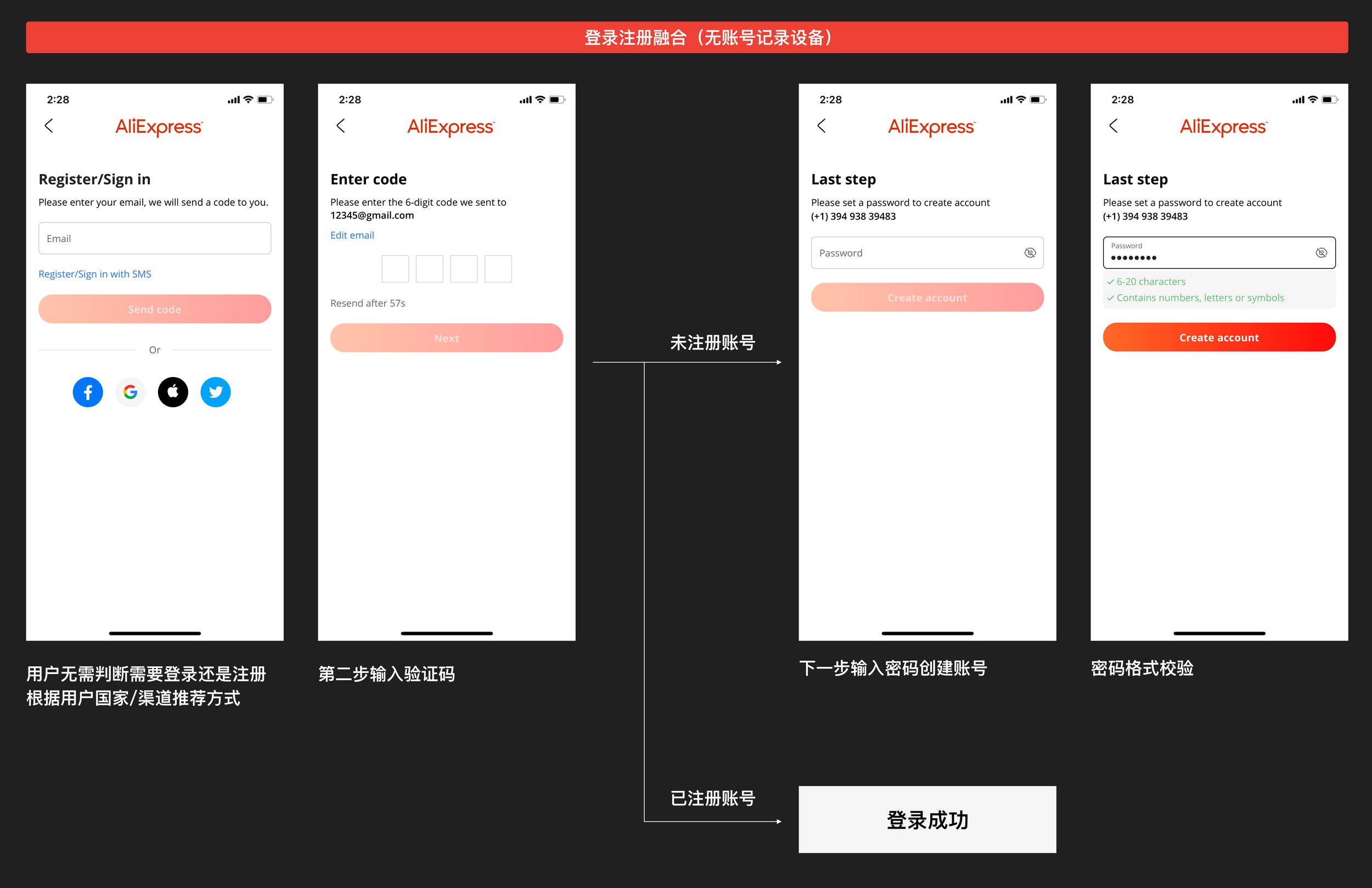
核心抓手:登录注册融合(无账号记录设备,用户只需输入账号,无需判断登录注册,有效减少重复注册率)
3. App 1.0 — Cross-Flow Optimization
Core Design Lever:
Unified Login & Registration: Recognize whether an account already exists on the device, allowing users to simply enter their account information without having to distinguish between Login and Registration, effectively reducing duplicate registration.
第二阶段:扩大规模.
PC/Msite 2.0:链路间 断点优化.
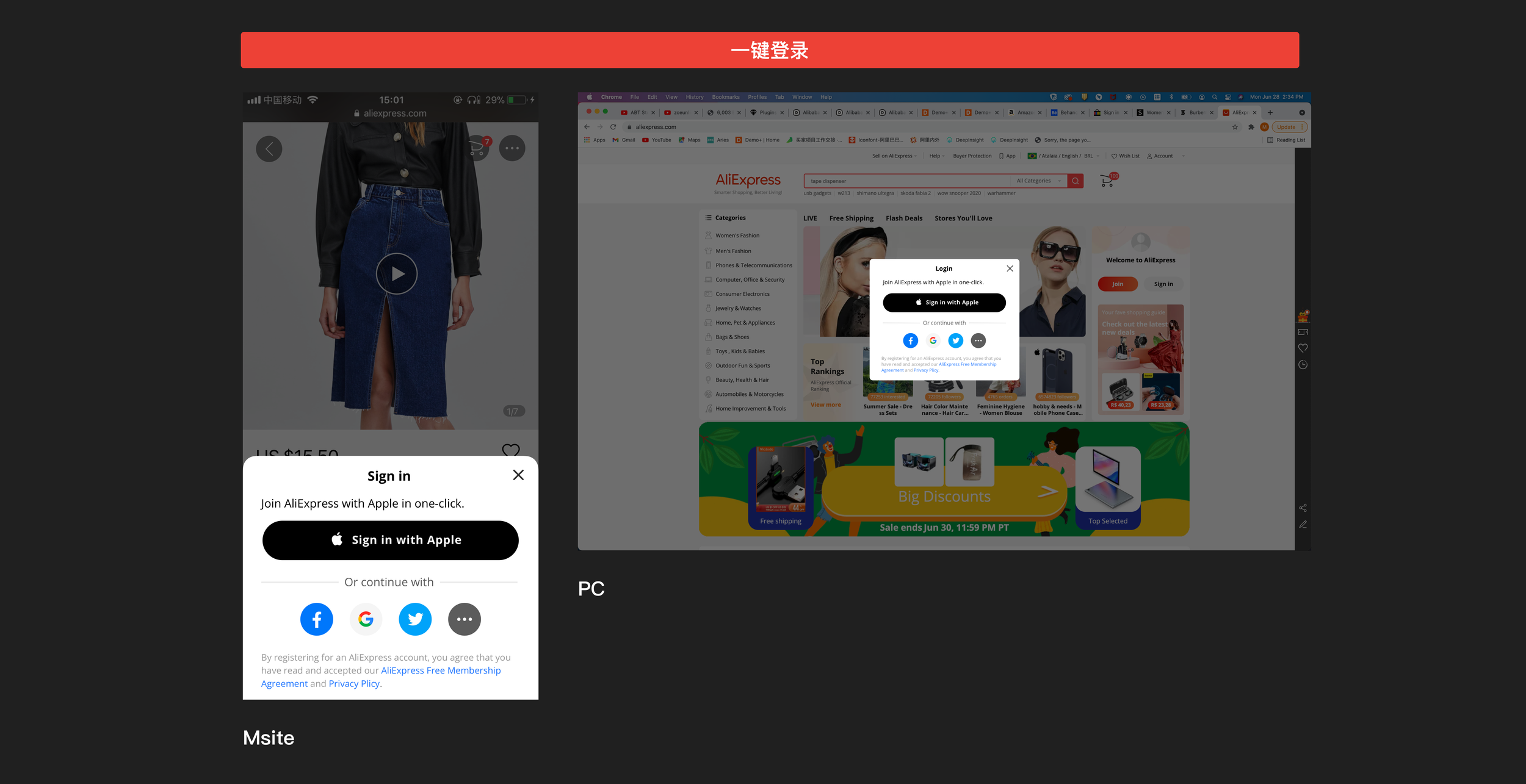
主要优化:a. 核心链路断点连接;b. 一键登录操作成本缩减;
核心抓手:a. 构建整套一键登录弹层方案且各业务场景接入;b. 分国家/渠道定制;c. 核心断点承接;
Phase 02 — Scale Growth
1. PC / M-site 2.0 — Cross-Flow Drop-off Optimization
Focus Areas:
Connect key journey drop-off points
Reduce the effort required for one-click login
Core Design Levers:
Build a unified one-click login modal and integrate it across key business scenarios.
Customize the login experience by country and traffic source.
Create targeted experiences to capture users at critical drop-off points.
数据结果:
第三方登录注册时间缩短了2秒左右。
场景接入一键登录数据结果:
购物车:c-po转化率相对提升26%
券投放:接入登录组件后,将券的领取交互更新为登录后无需二次点击自动领取,Msite端对照桶领券成功率为2.29%,实验桶领券成功率为3.11%,相对提升35.81%,带来日均1550领券用户数;PC端对照桶领券成功率为0.50%,实验桶领券成功率为0.65%,相对提升30.00%,带来日均730领券用户数
其他场景测试中
Data Results
Third-party login/registration: Reduced completion time by approximately 2 seconds.
One-click Login Integration:
Shopping Cart: C→PO conversion rate increased by 26% relative.
Coupon Distribution: After integrating the login component, users could automatically claim coupons after logging in without an additional click.
M-site: Success rate increased from 2.29% → 3.11%, a 35.81% relative increase, generating an average of 1,550 additional coupon claimers per day.
PC: Success rate increased from 0.50% → 0.65%, a 30.00% relative increase, generating an average of 730 additional coupon claimers per day.
Other scenarios: Testing was still ongoing.
2. App1.0: 链路间优化.
核心抓手:a. 新设备强化第三方登录注册(提升新人注册);
2. App 1.0 — Cross-Flow Optimization
Core Design Lever:
Strengthen Third-Party Login & Registration on New Devices to increase new-user registration.
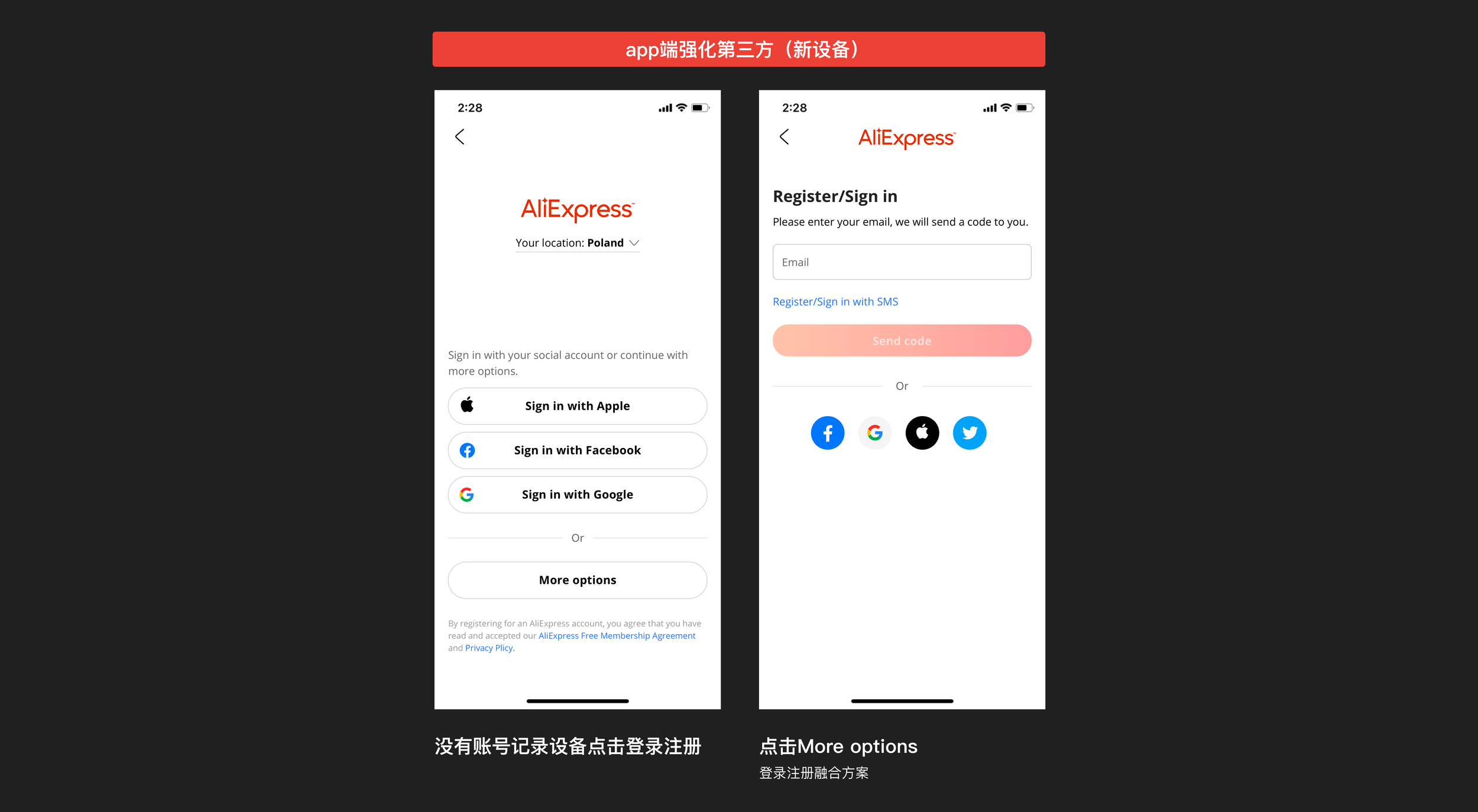
数据结果:注册成功率上升6pt,全量后增加新注册会员数2.8w/天
Data Results: Registration success rate increased by 6pp, generating an additional 28K new registered members per day after full rollout.
第三阶段:降低垃圾注册率,提高用户注册质量.
主要优化:a. 三端找回密码(点击找密UV 6.4w,找密登录成功UV 3.8w,漏斗59%); b. app端接入邮箱校验;c. 三端账号绑定优化;d. 提升用户召回.
核心抓手:a.一期优化免密码登录,弱化找回密码链路;b. app端邮箱校验优化(功能补足);c. 账号绑定优化(同时优化抓取用户第三方信息功能);d. 收集用户个人信息 / 优化用户个人信息(收集邮箱提升召回率,收集用户偏好精准个性化推荐)
Phase 03 — Reduce Spam Registration & Improve User Quality
Key Focus Areas
Password Recovery Optimization: 64K UVs clicked “Forgot Password,” but only 38K successfully logged in — a 59% conversion rate.
Email Verification: Introduce email verification on App.
Account Linking: Optimize account linking across App, PC, and M-site.
User Re-engagement: Improve user recall and reactivation.
Core Design Levers
Passwordless Login: Reduce reliance on the password recovery flow by introducing passwordless login.
Email Verification: Complete and optimize email verification capabilities on App.
Account Linking: Streamline account linking while improving the collection of third-party account information.
User Data & Personalization: Collect and enrich user information—such as email and preferences—to improve user re-engagement and personalized recommendations.
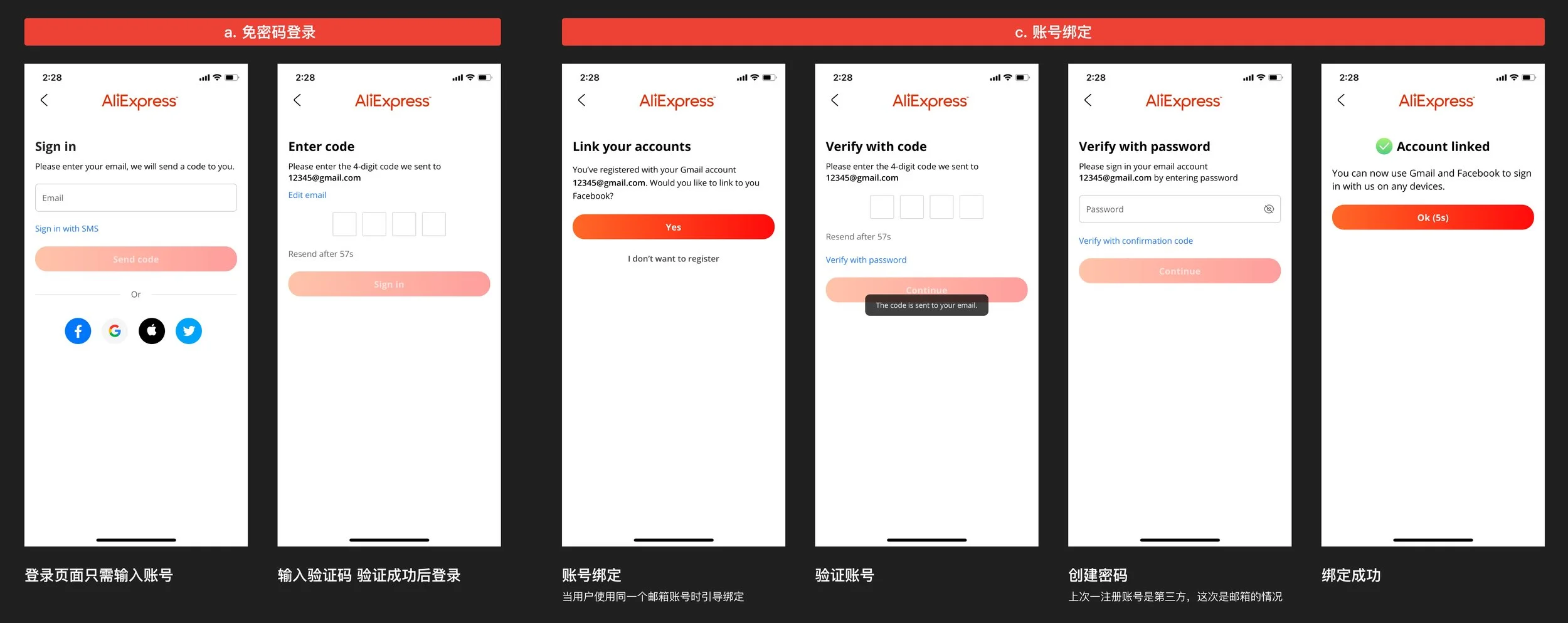
到目前为止,登录注册已完善了基建问题、体验优化、漏斗数据的提升,下一步的方向就是精细化的提升。登录注册是一个连接各个场域来到站内的桥梁,以及提升后续用户召回和转化,未来方向:
优化和增加登录注册入口,根据数据表现,从站外渠道来站内的UV来看,SEO/PPC/联盟仍然有很大的提升空间,通过增加和优化用户进站后登录注册的入口,并且融入到用户当下的场景去挖掘更好的注册方式,从而有效提升转化率
降低用户跳失率。从数据上来看,用户进入登录注册页面后的跳失率仍然很高,目标是下一阶段通过优化设计来提升10%,手段可以是给用户充分的理由以及简化注册的动作,让用户有动力注册且操作简单
提升用户粘性,通过收集用户个人信息、喜好、好友关联,从而提供内容价值(精准个性化推荐),场景价值(拓展多种场景覆盖面,让用户可以从更多的场景访问站内),社交价值(打造圈子,通过社交关系粘住用户)
Next Steps — From Optimization to Growth
So far, the login and registration experience has addressed infrastructure, UX, and funnel conversion. The next stage is to move toward more targeted, data-driven optimization.
Login and registration is not just an entry point—it is a bridge connecting off-site traffic to the on-site experience, as well as a foundation for user re-engagement and conversion.
01 — Expand & Optimize Entry Points
Data shows significant growth opportunities remain across SEO, PPC, and Affiliate traffic.
I would optimize and expand login/registration entry points based on traffic behavior, integrating registration naturally into users’ current context and intent to improve conversion.
02 — Reduce Drop-off
The drop-off rate after users enter the login/registration flow remains high.
The next goal is to reduce drop-off by 10% through:
Stronger reasons to register · Fewer actions · Simpler flows
The objective is to make registration both worthwhile and effortless.
03 — Increase User Stickiness
Use user data to create longer-term value across three dimensions:
Content Value
Collect preferences to enable more personalized recommendations.
Context Value
Expand the number of scenarios through which users can access and return to the platform.
Social Value
Build social connections and communities that create stronger reasons for users to stay and return.
From registration as a conversion point → to registration as the foundation for long-term user growth.
思考与沉淀
每开始一个新的项目,首先定位问题是什么,手段可以是数据分析和用户调研。然后针对问题,依次从三个层面给出解决对策,通常会是链路层、框架层、内容层,但是并不是任何的项目都非要层这三个层面给出方案,什么维度在这个项目中好用就用什么,切记别套模板。能抓到耗子的维度就是好猫。比如登录注册的项目我定义的是感知层,操作层,意愿层。接下来,就针对这些对策依次出设计稿解决。
需要注意:
贯穿始终的针对性。每个方案都是针对性的解决设计师发现的问题,不要抛出问题不解,也不要解决别的问题。另外,后面的设计稿一定要针对设计师提出来的每个问题、每个方案出。着重考量后面出的设计稿是否真的有解决设计师提出的问题并对结果负责;
解决方案不要太散。要归类为大的点,细节的塞里面,不要解决方案搞出来20个点,后面自己都乱了。
Reflection & Takeaways
When starting a new project, I first define what the actual problem is, using methods such as data analysis and user research.
I then develop solutions from the dimensions that are most relevant to the problem. These might include Journey, Framework, and Content, but not every project needs to address all three.
Don't force a framework onto the problem. Use whatever dimension best solves it.
For example, in the Login & Registration project, I defined the problem across three dimensions:
Perception → Action → Motivation
Once the solution directions are defined, I translate each one into concrete design solutions and validate whether the final designs actually address the problems identified.
Key Principles
01 — Stay Problem-Driven
Every design solution should directly address a problem identified through research or analysis. Don't introduce problems you cannot solve, or solve problems you never identified.
Every design output should trace back to a specific problem → solution → result.
02 — Keep Solutions Focused
Don't turn one project into a collection of 20 disconnected solutions.
Group details under a few clear, strategic directions, so the relationship between the problem, solution, and final design remains easy to understand.
The best framework is the one that catches the mouse.
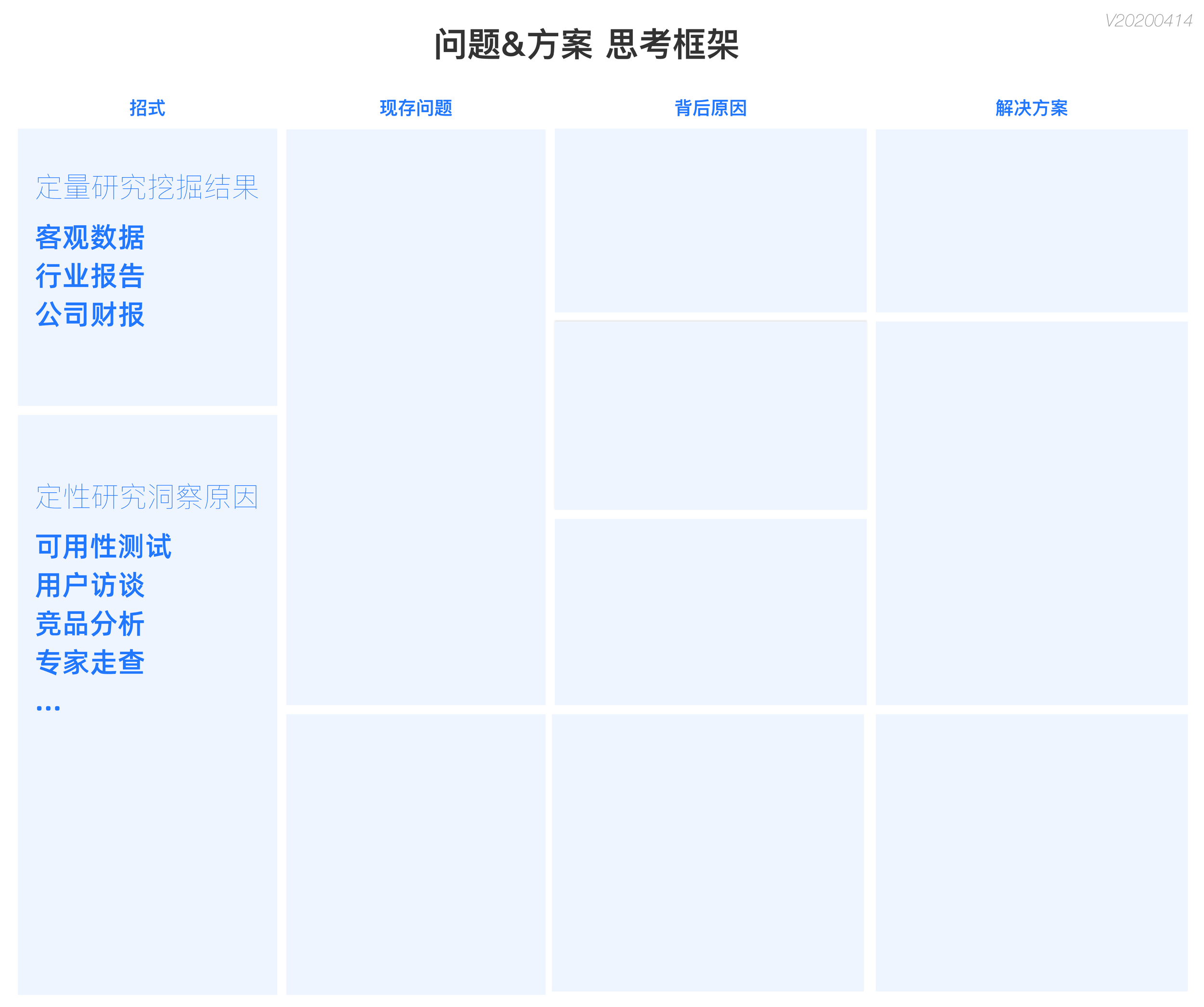
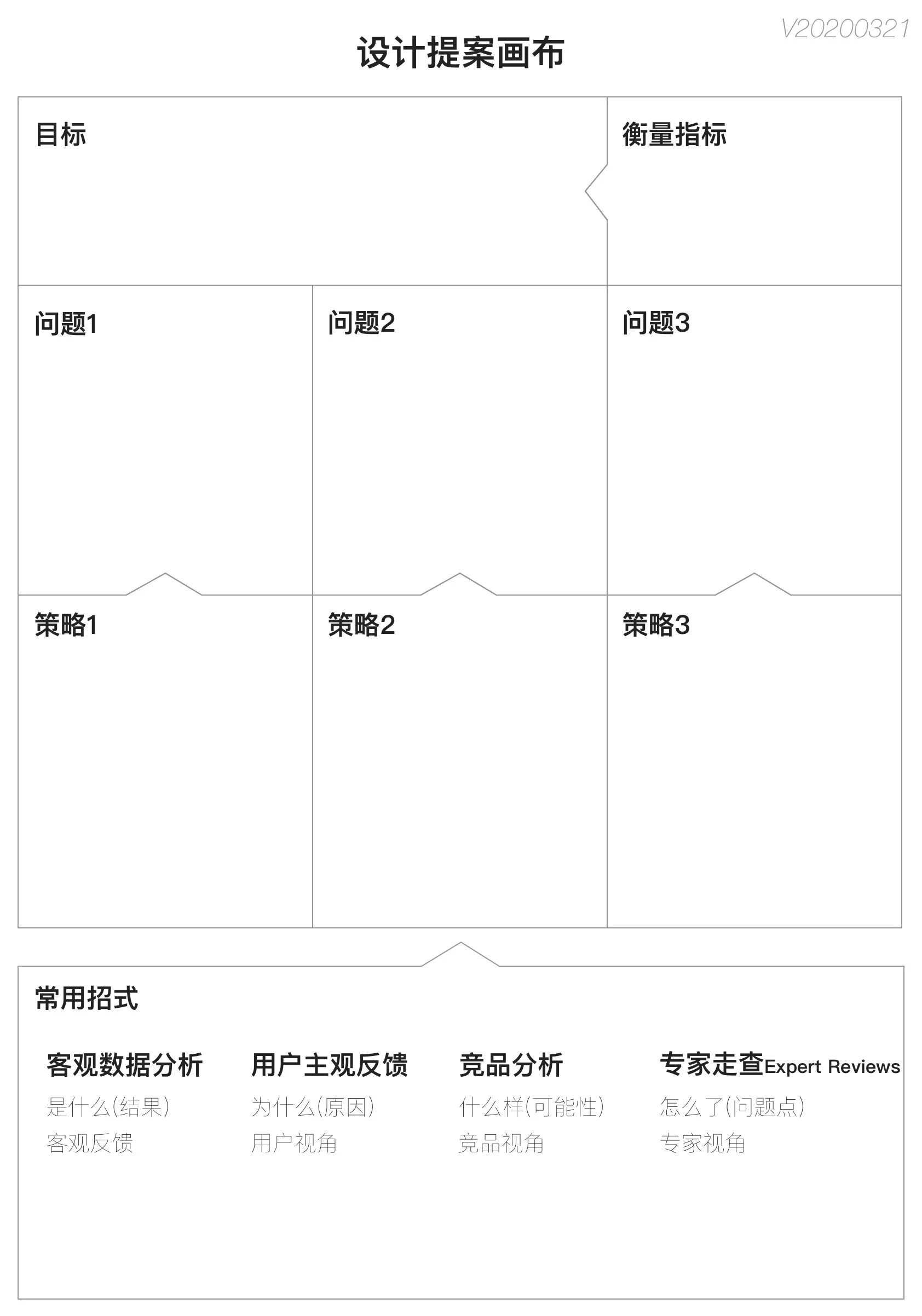
上面是从思考过程来看,再换个角度,从结果来看,设计师也可以使用下面的框架图。